
Audit Overview
Your store's untapped revenue potential — and how to unlock it
Why We Created This Audit
We analyzed https://www.off---white.com/en-in/ the same way we've audited 350+ e-commerce stores — looking for the specific gaps between your current experience and what top-performing Fashion stores deliver. Every finding in this report is a revenue opportunity backed by industry data and competitive benchmarks.
What We Analyzed
- UX & Conversion Design15 findings
- Technology & App StackPlatform + 11 apps
- Industry BenchmarksFashion
Pages Analyzed
- Homepage4 findings
- Collection Pages3 findings
- Product Pages (PDP)6 findings
- Cart & Checkout2 findings
 This audit was prepared by Growisto — a CRO-led Website development team behind 167% conversion growth for Atomberg, 46% CR lift for TyresNmore, and 350+ e-commerce projects.
UX & Conversion Findings
Page-by-page analysis with visual comparisons against top Fashion stores
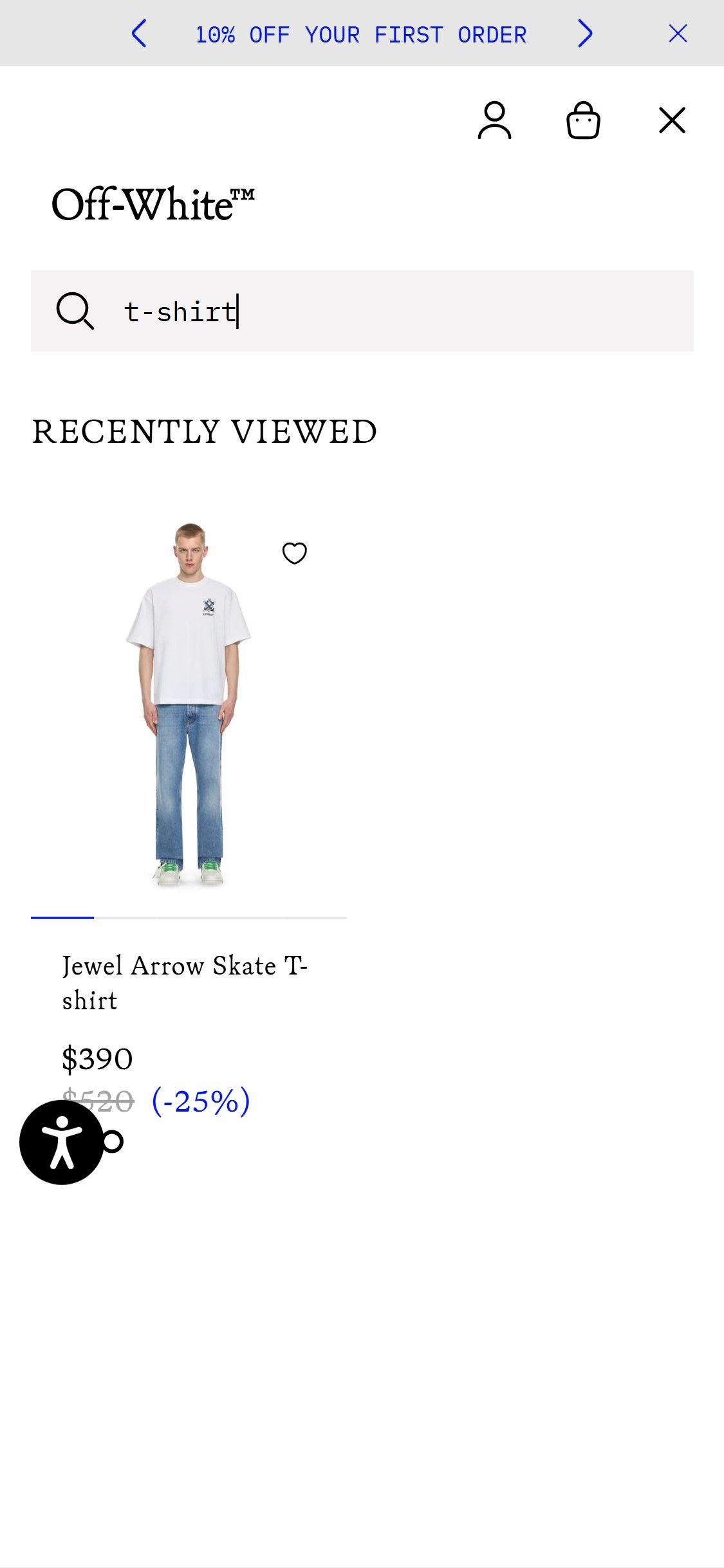
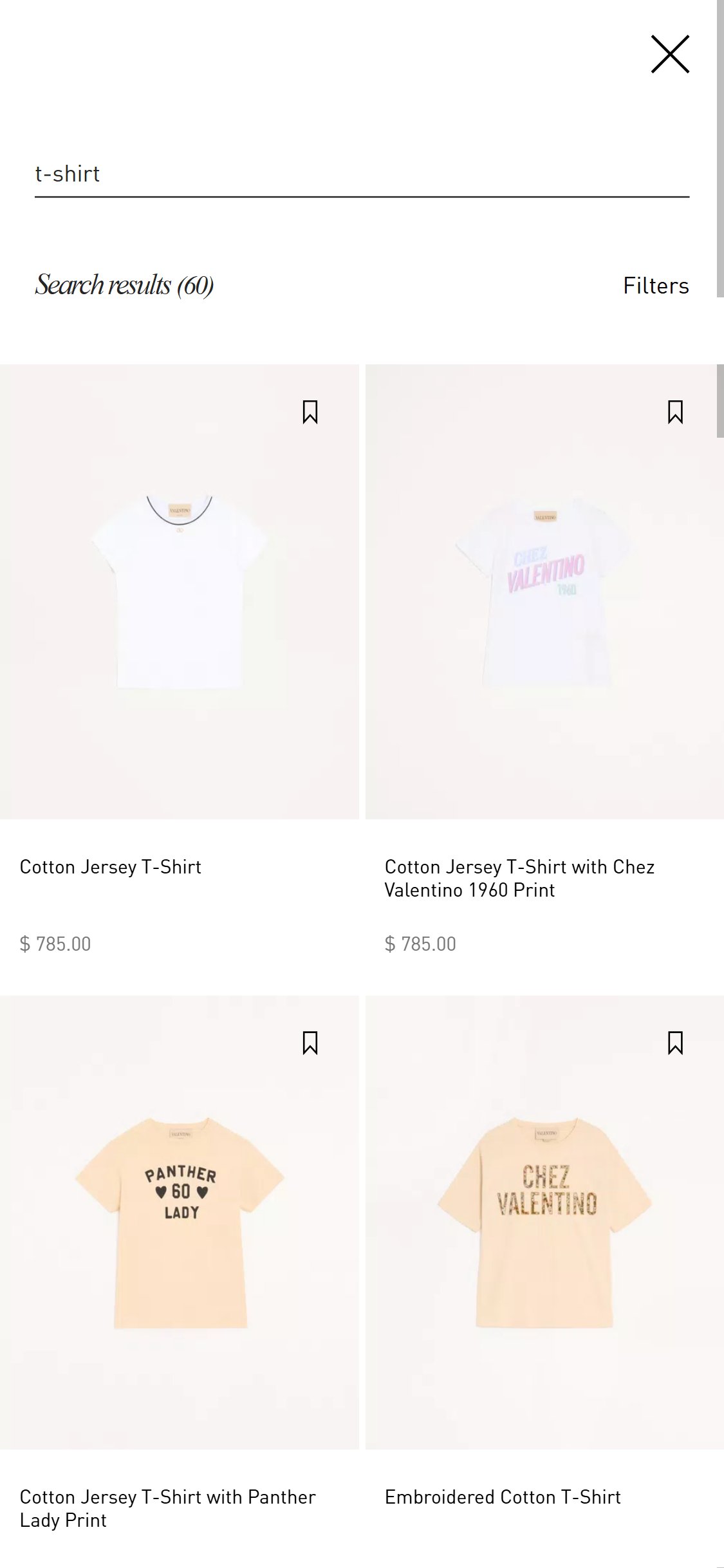
- Typing 't-shirt' in the search bar shows only a 'RECENTLY VIEWED' product tile — no dropdown suggestions, no autocomplete, no category hints
- User must press Enter/submit to see any search results, adding friction to discovery
- Competitor fashion brands use AI-powered predictive search that surfaces product names and categories while typing
- This is especially critical for a brand with luxury price points where discovery friction directly reduces conversion
- Implement predictive/autocomplete search that surfaces product names, categories, and editorial content after 2+ keystrokes
- Show trending searches and recently popular items in the empty search state
- Consider visual search results showing product thumbnails with prices in the dropdown — the current setup loses shoppers who won't press Enter
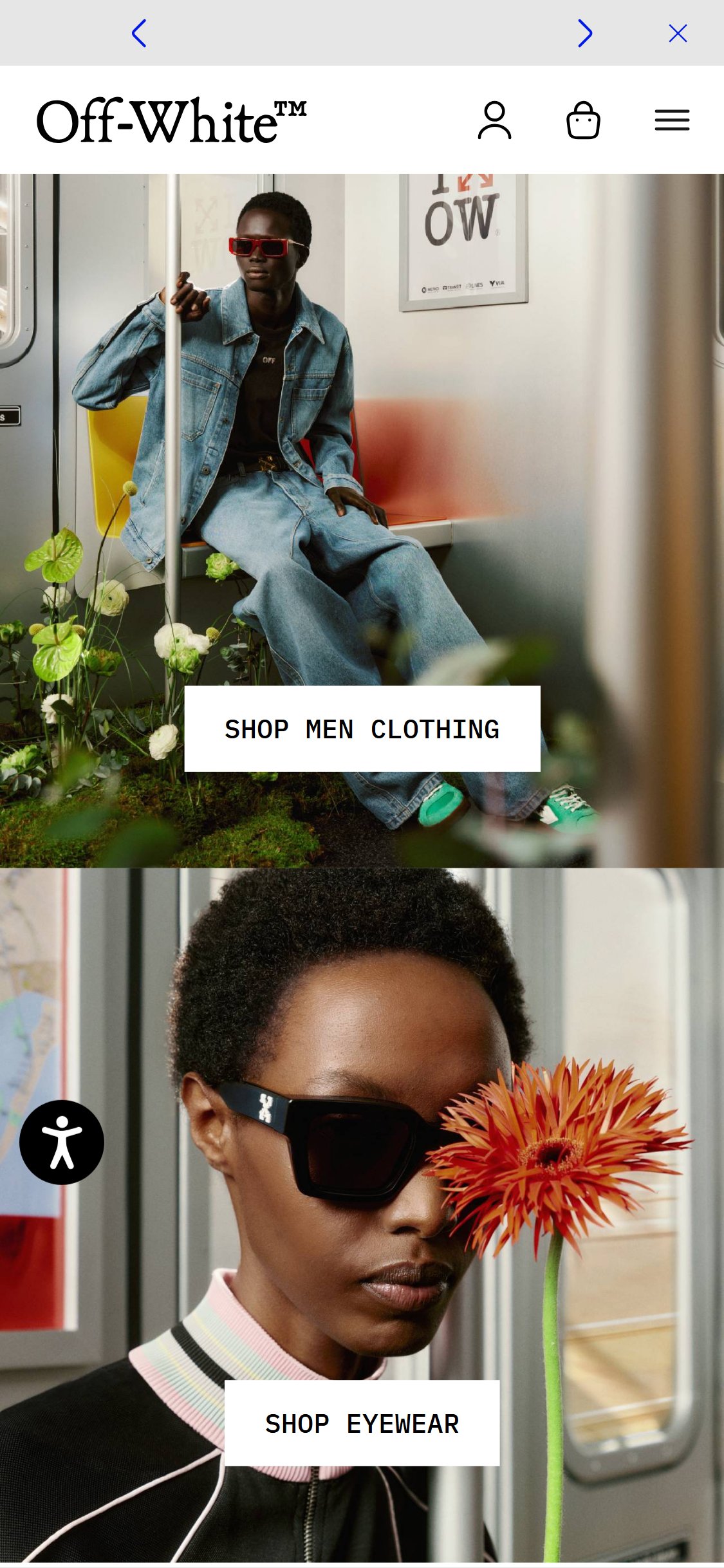
- Homepage first two scrolls contain only full-bleed editorial images with category CTAs — zero iconographic trust or USP elements
- No free shipping callout, no return policy badge, no 'Genuine Product' guarantee, no secure checkout icon
- For a brand selling ₹30,000–₹90,000 items to India buyers, absence of trust signals is a first-visit conversion killer
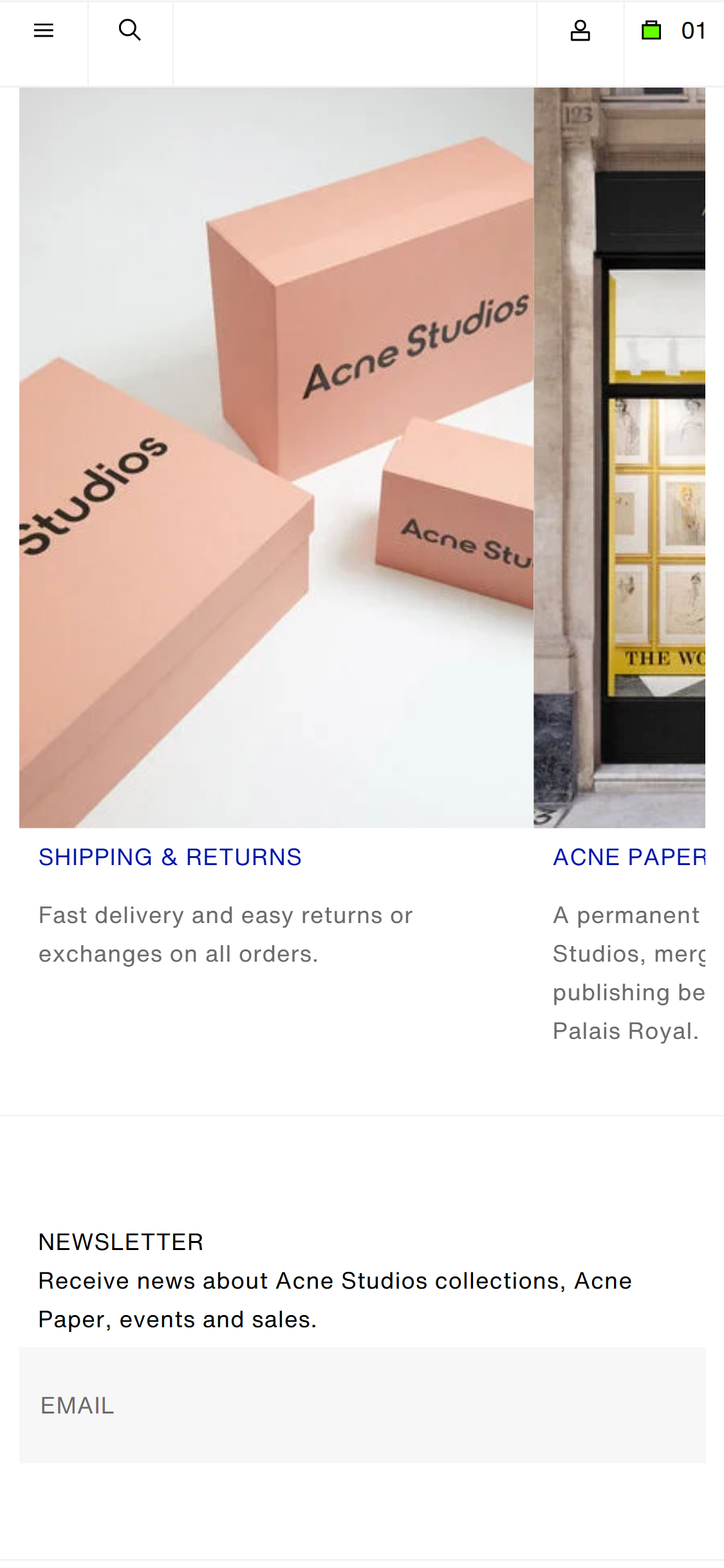
- Footer-only trust information forces users to scroll past all content before finding any reassurance
- Add a USP strip below the hero section with 3–4 icons: 'Free Returns', 'Worldwide Shipping', 'Authentic Off-White™', 'Secure Payment' — keep it minimal to match brand aesthetic
- Include a subtle 'Genuine Product Guaranteed' or authentication mark near the header logo for luxury reassurance
- Even a single line of text above the fold ('Free Returns · Secure Checkout · Official Off-White™ Store') would meaningfully reduce bounce for first-time India visitors
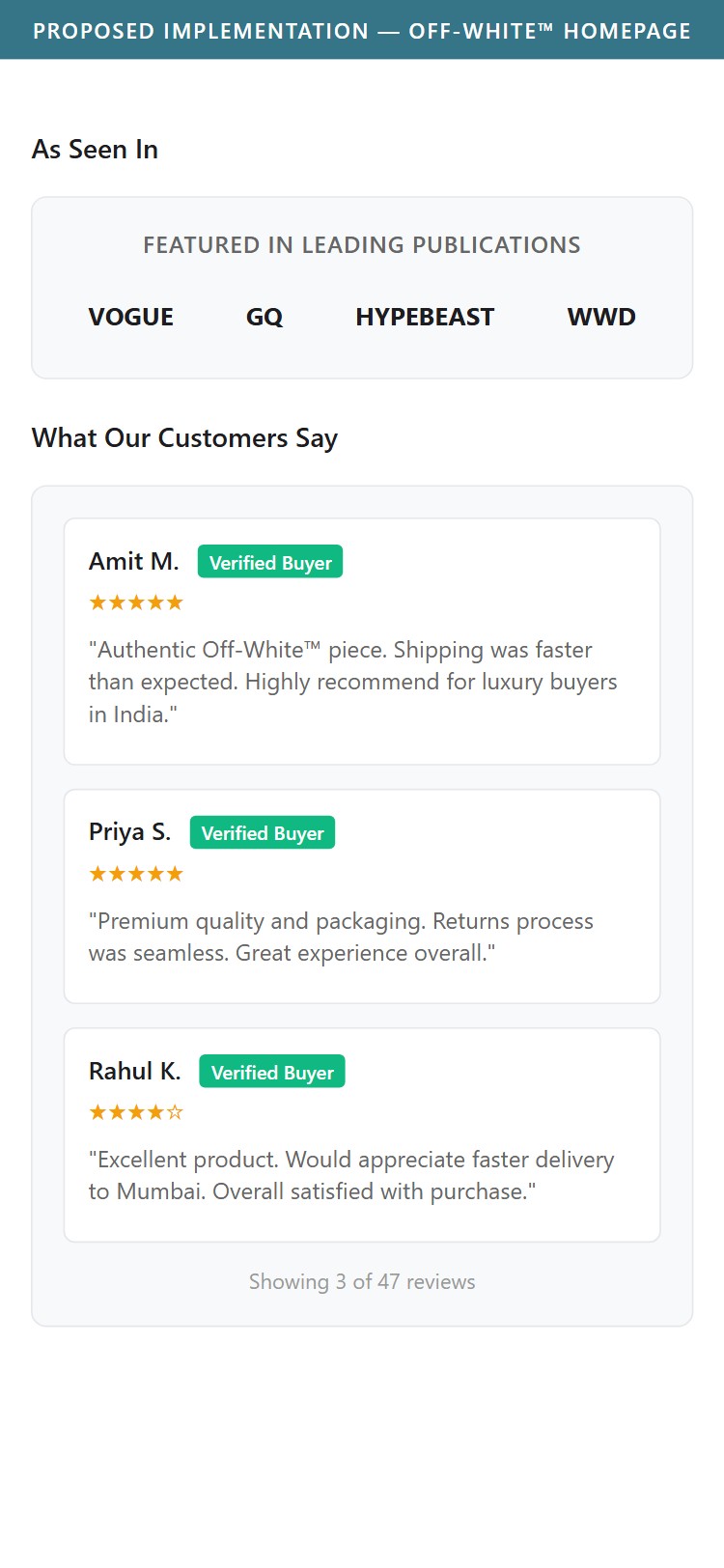
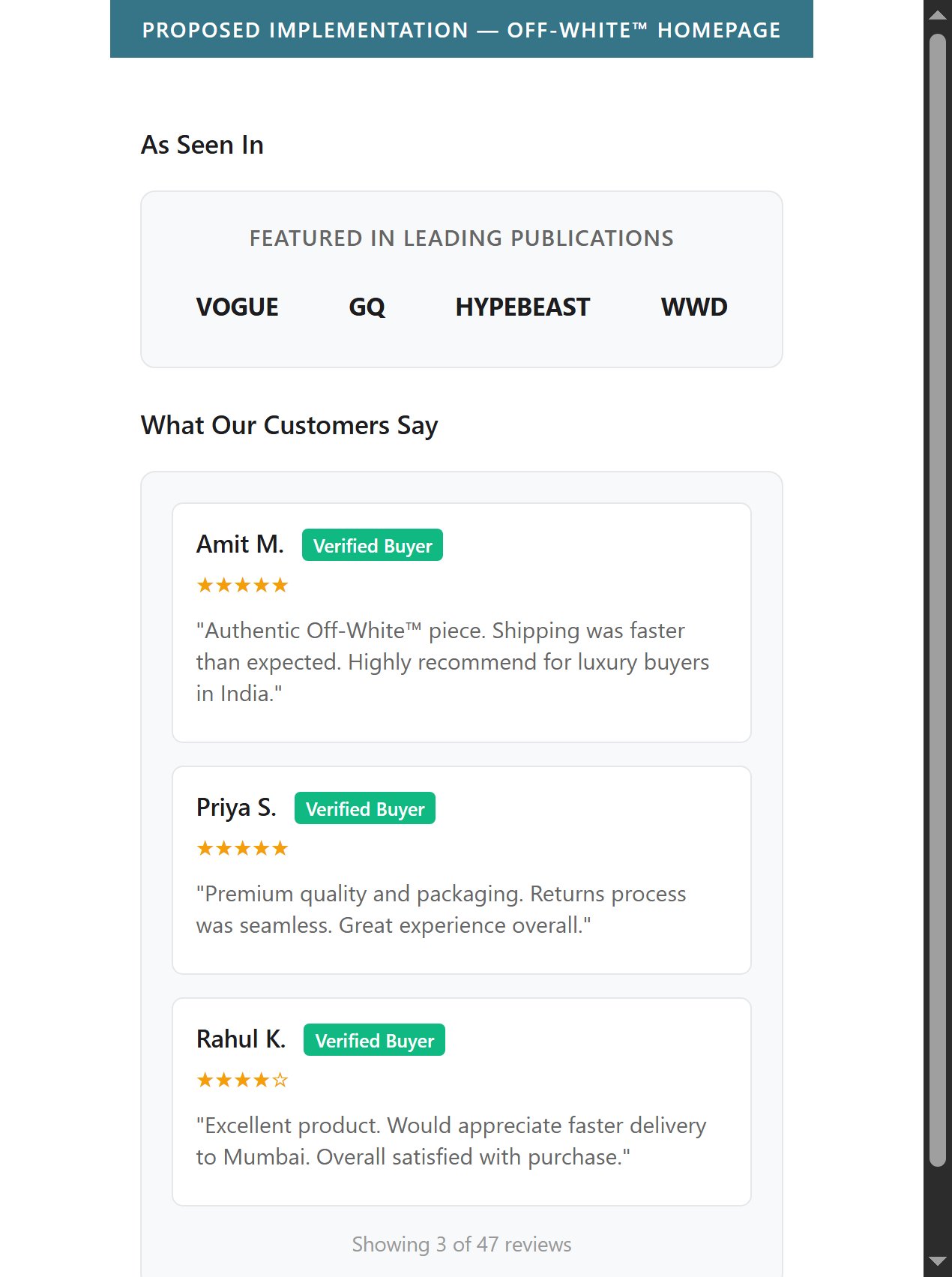
- Homepage contains no customer review carousel, no press/media logos ('As Seen In'), no testimonials, no platform rating display
- For India buyers unfamiliar with luxury brand authentication online, absence of social proof increases purchase hesitation significantly
- The 10x10 campaign editorial section provides brand credibility but is artist-focused, not customer-voice based
- Benchmark: 7/10 fashion stores show star ratings on product cards; competitor luxury brands use editorial + social proof together
- Add an Instagram UGC feed or curated customer photo gallery section on the homepage — shows real product in real-world context
- Include a press/editorial strip ('As seen in Vogue, GQ, Hypebeast') which aligns with Off-White's brand equity and provides third-party credibility
- A minimal review carousel (3–5 reviews, no stars required — text-only) from verified India buyers would directly address local purchase hesitation
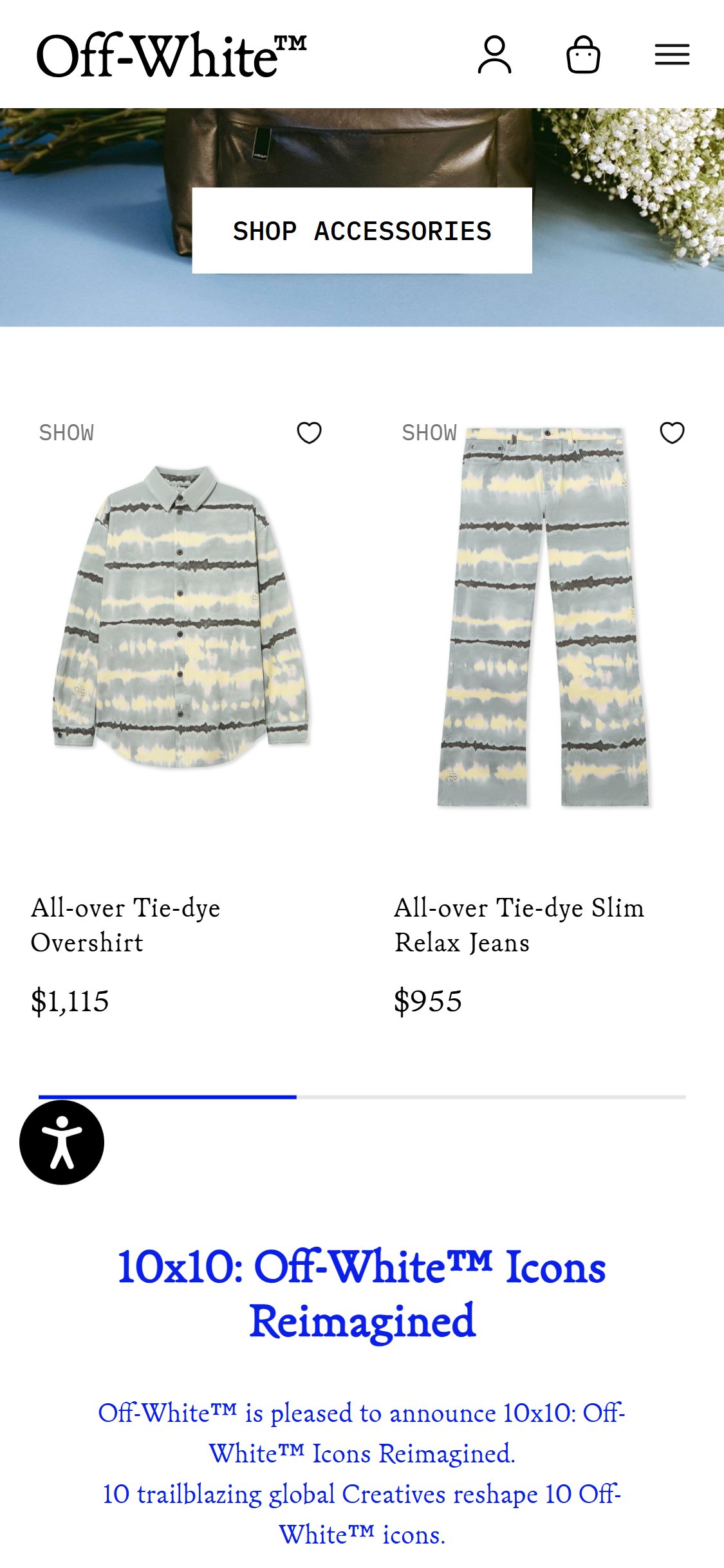

- Product tiles on homepage (bestsellers, new arrivals sections) show image + title + price + wishlist icon only
- No 'Add to Cart' button, no quick-add icon, no hover mechanism to add to bag from the homepage
- Every product interaction requires navigating to PDP, increasing click depth and abandonment opportunity
- Wishlist icon is present on tiles — showing the infrastructure exists for tile-level actions
- Add a subtle 'Quick Add' icon (bag+) that appears on tile hover/tap — for fashion, this needs size selection, so a mini size picker overlay would work
- At minimum, add a 'Quick View' CTA that opens a modal with size selection + ATC without leaving the homepage
- For luxury context, a 'Save to Wishlist' + 'Quick View' combination is more brand-appropriate than a hard ATC
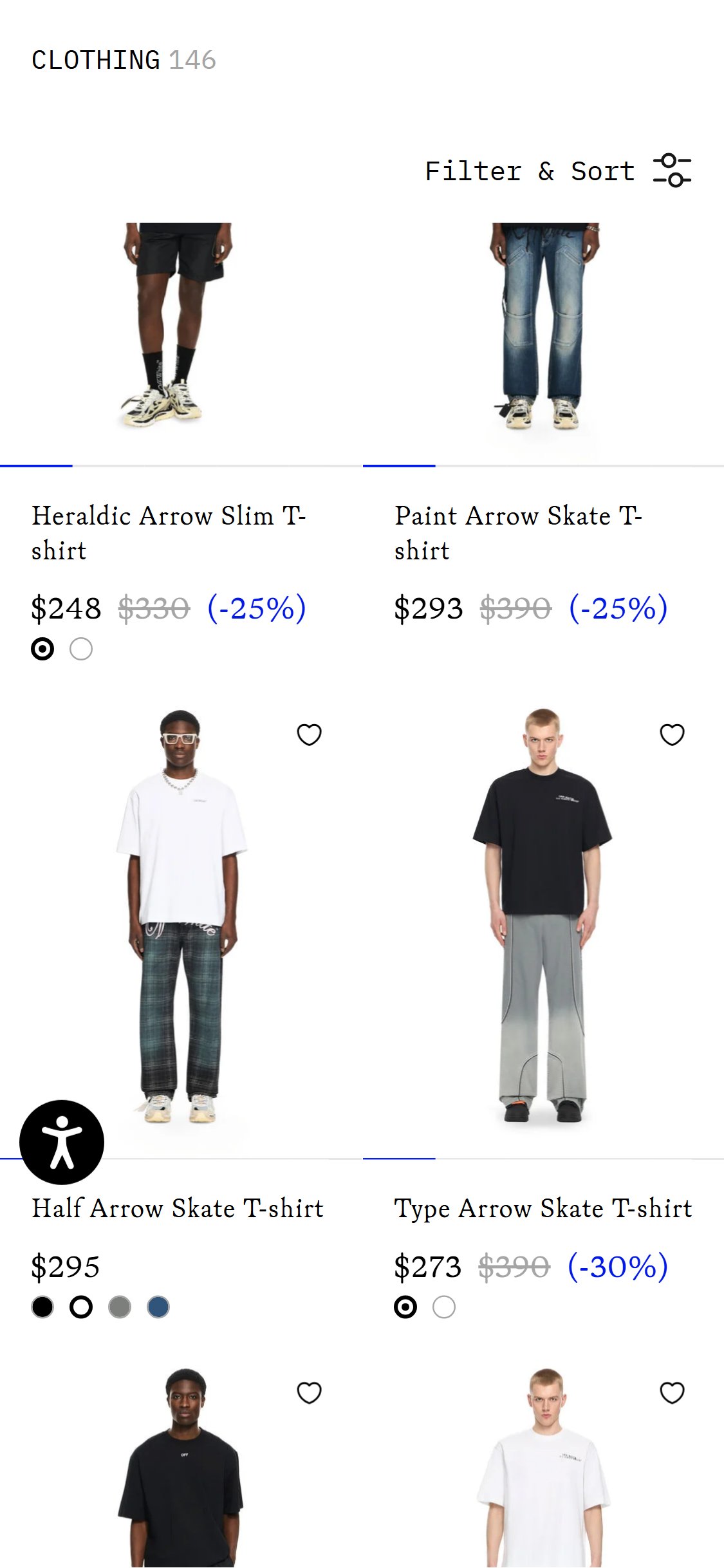
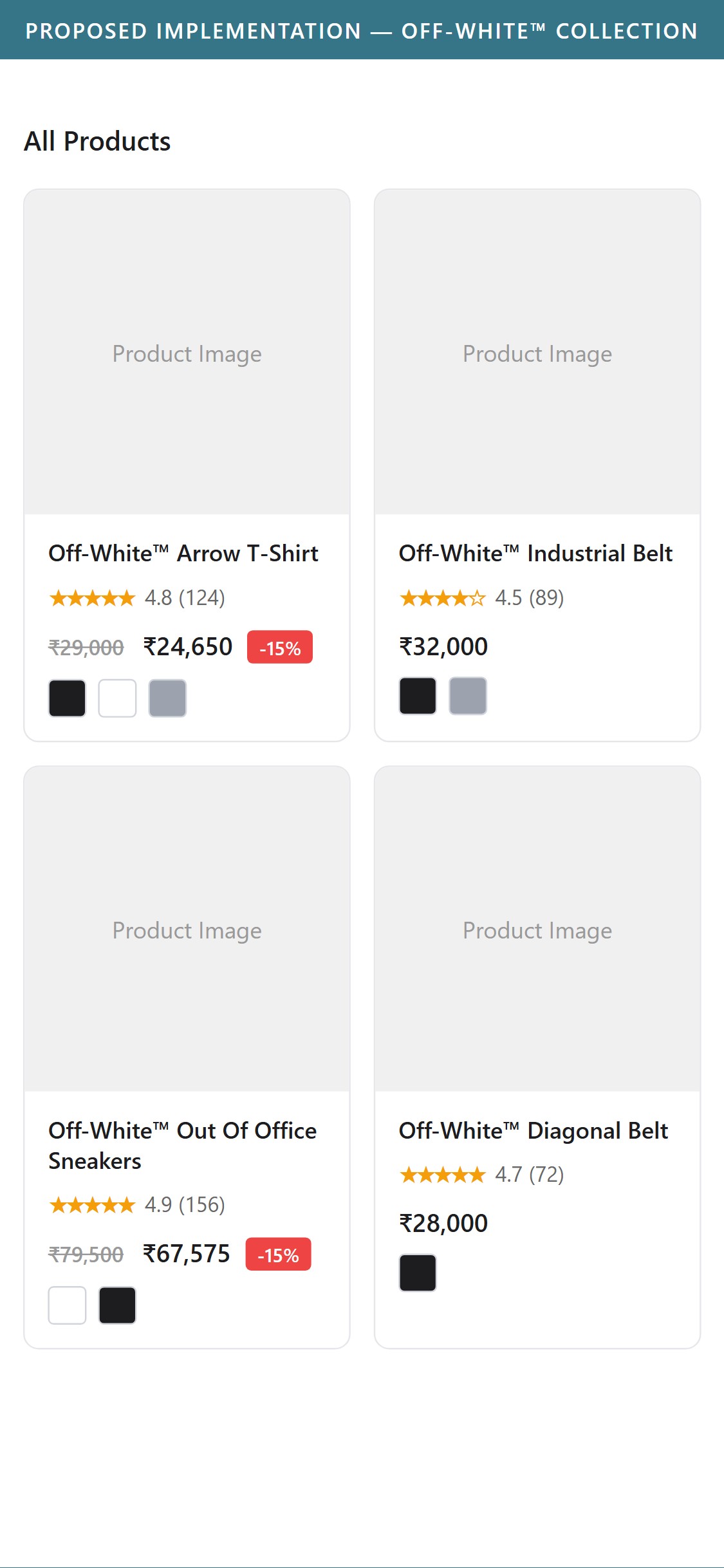
- Collection product cards show: image, title, sale price with strikethrough, discount percentage, and color swatches — no star rating or review count
- Star ratings on collection tiles are the highest-leverage social proof placement — they influence click-through to PDP before a user commits to scrolling
- Off-White has no review system at all on the site, so cards inherit this gap
- 8/10 benchmark stores lack star ratings on collection cards — but for a brand at this price point, the absence is more impactful
- Implement a customer review system (Yotpo or custom) that surfaces aggregate star ratings (e.g. 4.8★ 124 reviews) on collection tiles
- Even a simple aggregate score from the brand's app or community could be surfaced here — the key is showing social validation before the PDP
- Short-term: surface 'Best Seller' or 'Community Favourite' badges on top-reviewed items as a proxy for social proof
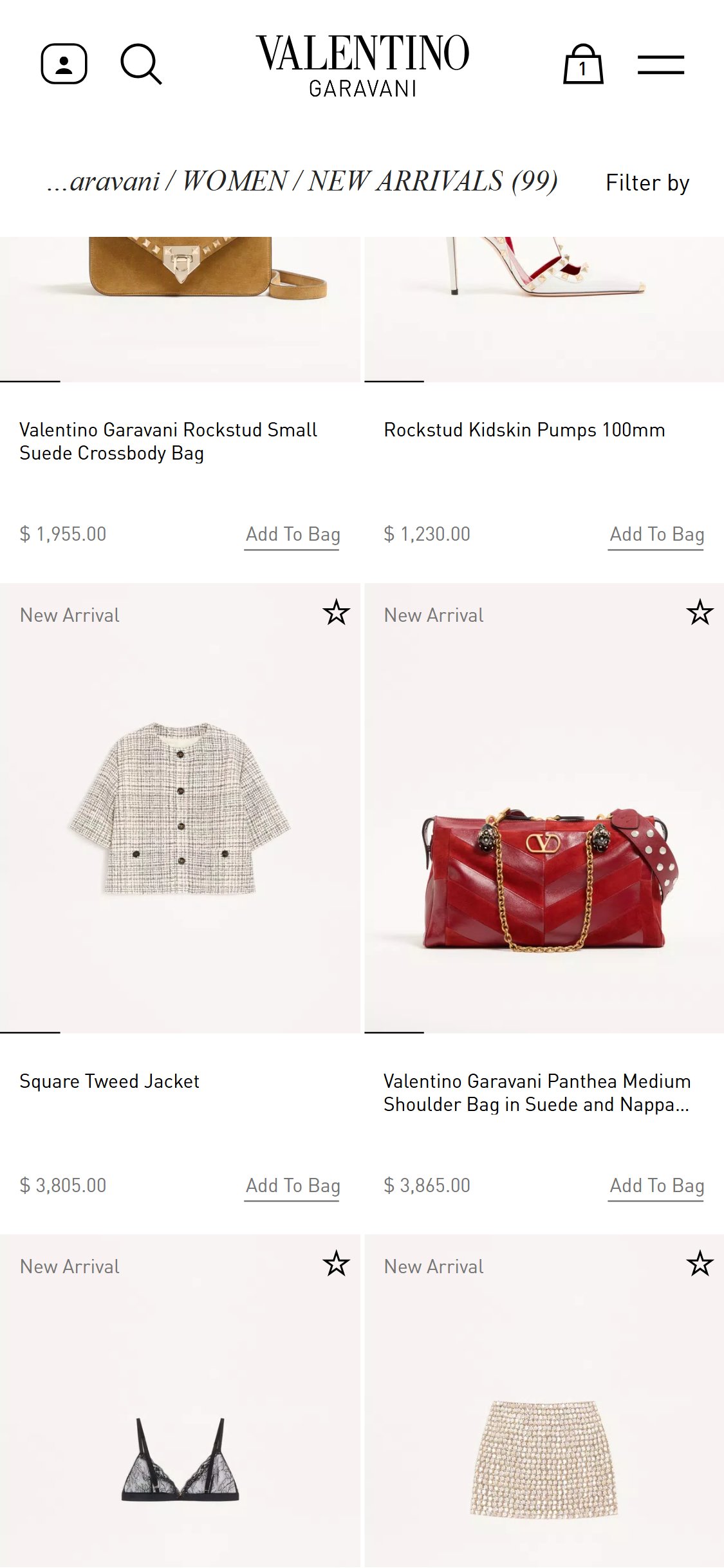
- Collection page has no Quick View popup and no Quick Add button on product tiles
- The only way to see product details or add to cart is to navigate to the full PDP
- This increases click depth and reduces browse-to-cart efficiency, particularly for mobile users comparing options
- Color swatches are present on cards — showing the product has multiple variants worth quick-previewing
- Add a Quick View modal triggered by a 'Quick View' button that appears on tile tap/hover — show main image, price, size selector, and ATC
- For luxury UX, a slide-up panel from the bottom on mobile works better than a modal — keeps the browse context visible
- At minimum, add a color swatch click that changes the tile image without navigating away
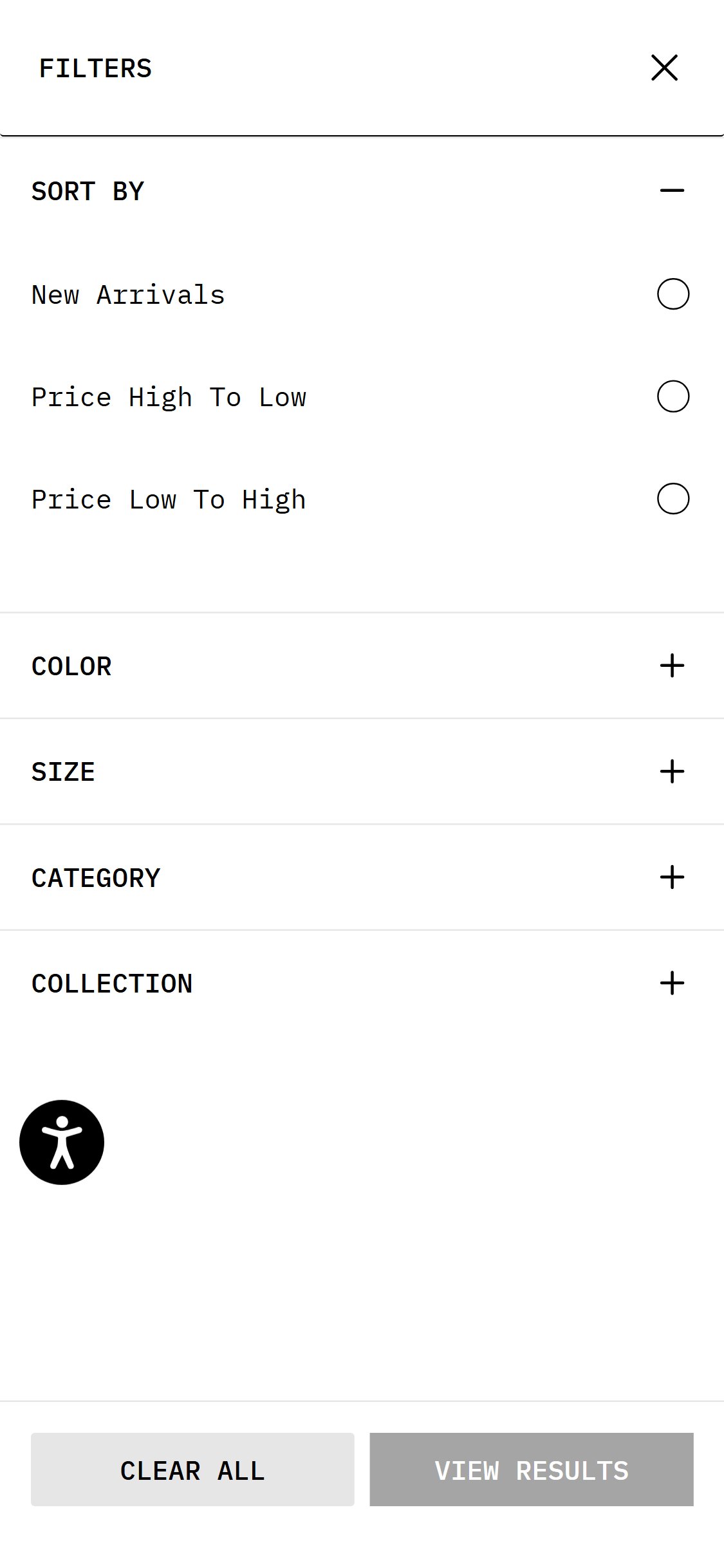
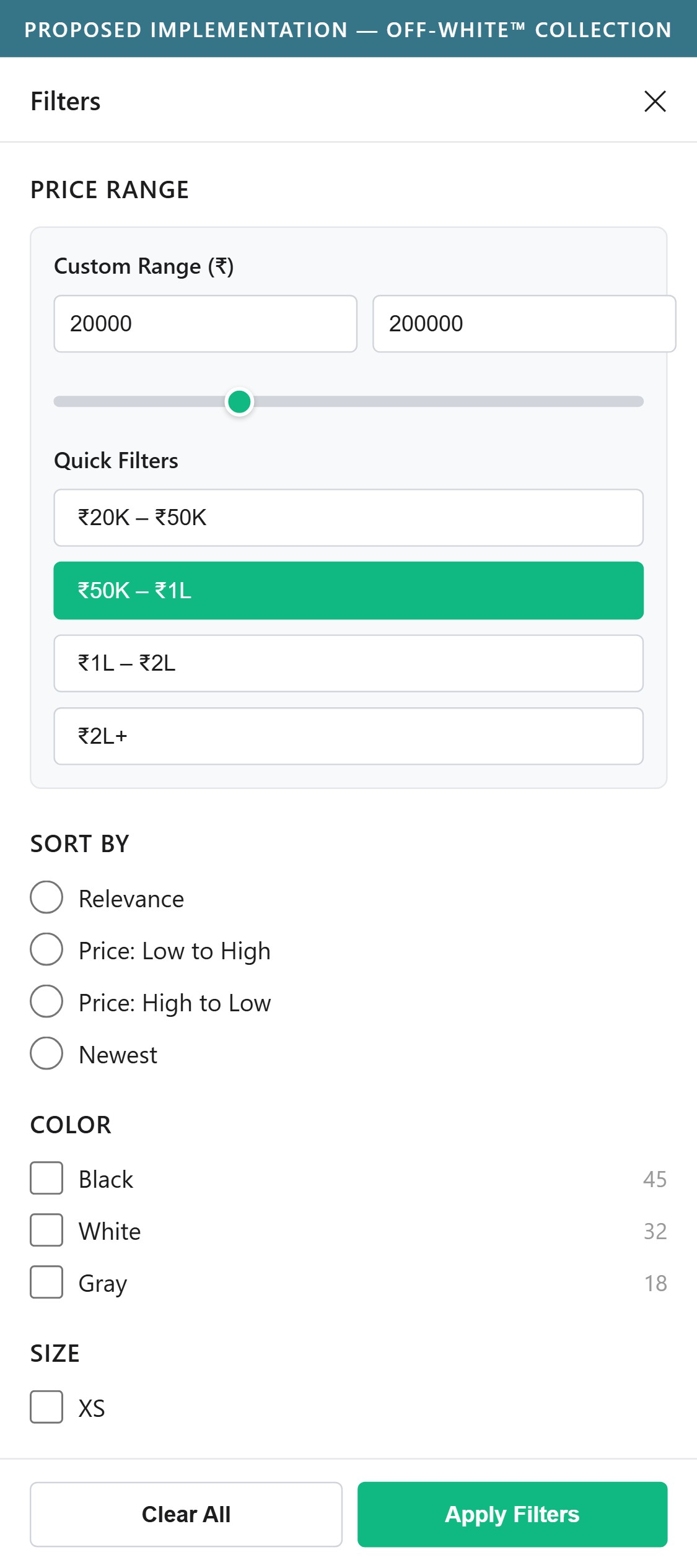
- Filter panel offers Sort By, Color, Size, Category, and Collection — no price filter of any kind
- Clothing collection spans a wide price range (₹20,000–₹2,00,000+) making price filtering essential for India buyers with specific budgets
- Absence of price filter means budget-conscious luxury shoppers must scroll through the entire collection to find affordable options
- Sort By 'Price Low to High/High to Low' is present but only helps with order, not filtering to a budget range
- Add a price range slider or min/max input to the filter panel — allow users to set custom ranges (e.g. ₹20,000–₹50,000)
- Pre-set price brackets (₹20K–₹50K, ₹50K–₹1L, ₹1L+) as a quick-select alternative if a full slider isn't feasible
- This is particularly important for India market where EMI decisions depend on the price bracket the shopper is targeting
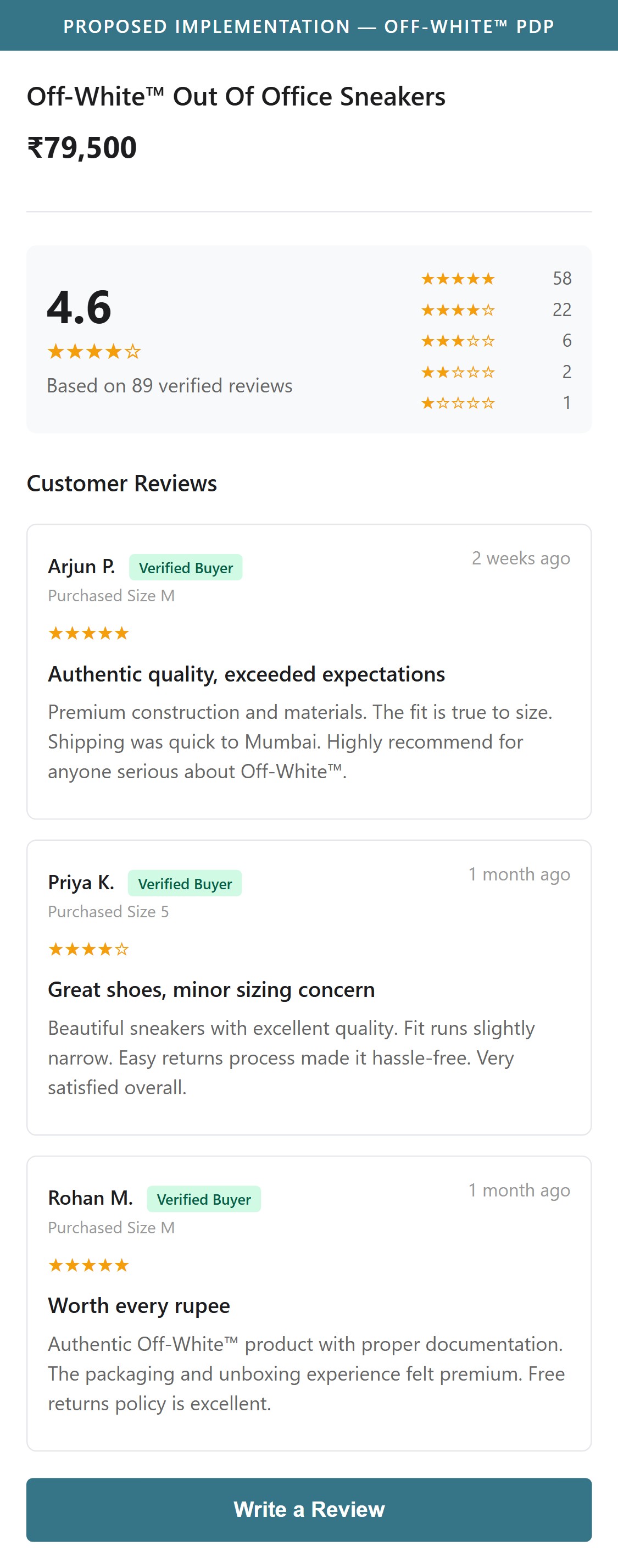
- PDP has no reviews section, no star ratings, no review count — the page ends with 'Style With' product recommendations after the accordion sections
- Above fold: product title, price with discount, ATC button — no rating widget, no review count, nothing
- For products priced $250–$1,000+, customer reviews are the primary trust mechanism for first-time buyers
- DOM inspection confirms zero review-related elements or third-party review widget scripts on the page
- Integrate a customer reviews system (Yotpo Premium, Okendo, or custom) that shows star ratings above fold near the product title
- Minimum viable: show aggregate rating (4.6★ based on 89 reviews) below the product name — this alone lifts PDP conversion significantly
- For luxury brand context: curated editorial reviews or verified buyer testimonials are more brand-appropriate than generic star ratings — implement a 'Verified Buyer' section below product details
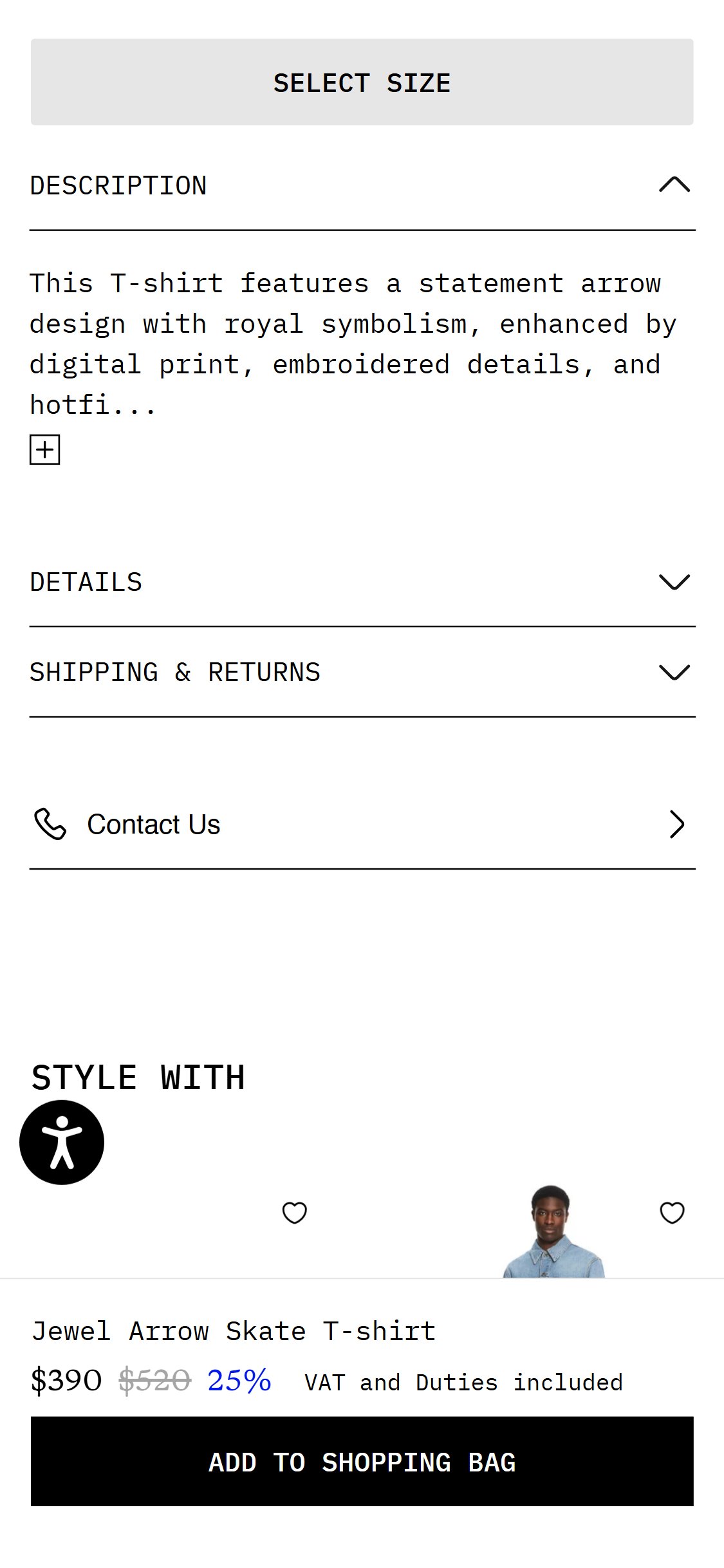
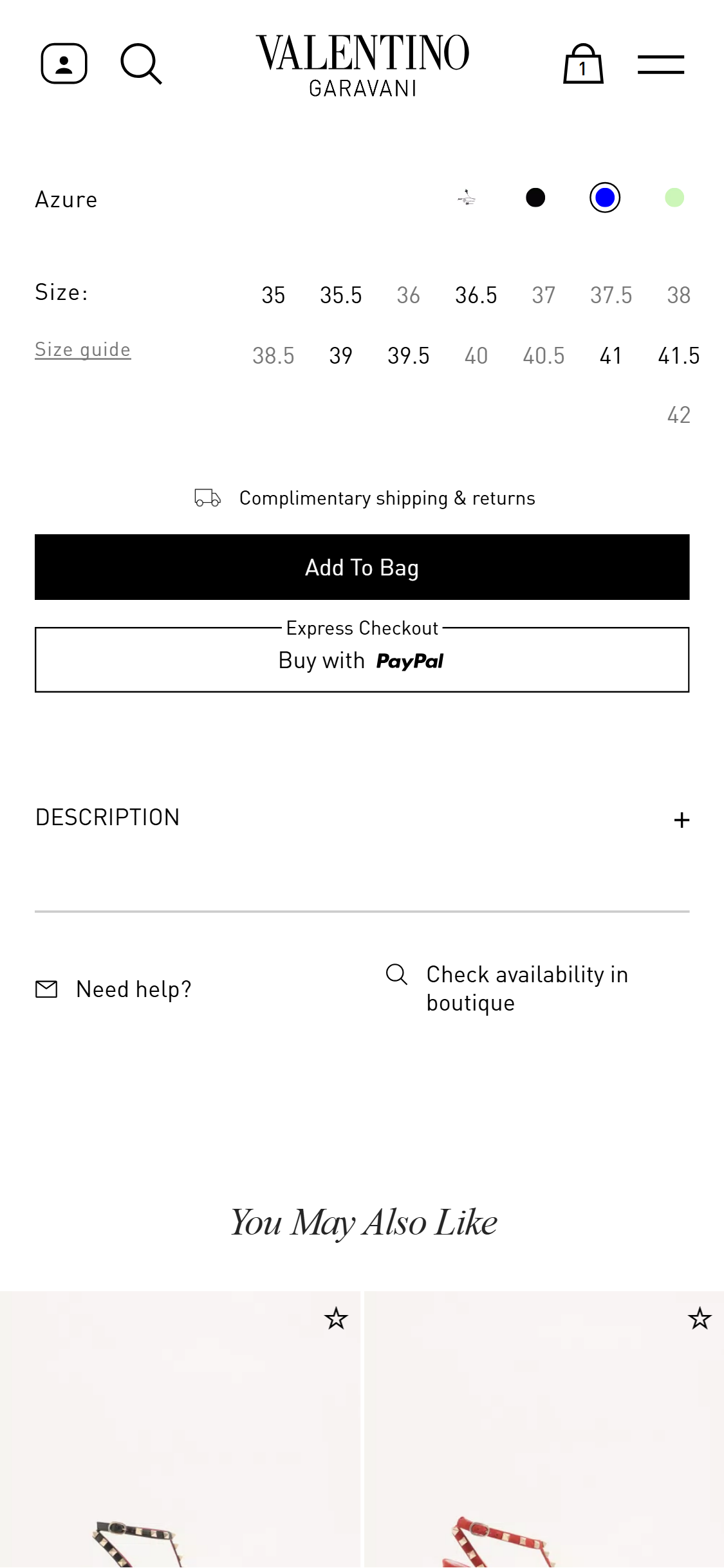
- The ATC zone (between price and below the Add to Cart button) contains only accordion sections: DESCRIPTION (open), DETAILS (closed), SHIPPING & RETURNS (closed)
- No secure payment badge, no authenticity guarantee, no return policy icon, no 'Genuine Off-White™ Product' mark near ATC
- Shipping & Returns policy is buried inside a collapsed accordion — high-effort to find for a first-time buyer
- At $300–$1,000 price points for India buyers, the absence of visible return policy and security indicators near the ATC is a significant conversion barrier
- Add 3–4 micro-trust icons directly below the ATC button: 'Free Returns', 'Authentic Product', 'Secure Checkout', 'Ships from Official Store'
- Surface the core return policy as a visible text line ('14-day free returns') rather than hiding it in the SHIPPING & RETURNS accordion
- Add payment method icons (Visa, Mastercard, UPI, Klarna) near the ATC to reinforce secure payment — Klarna is already installed but not shown as a trust signal
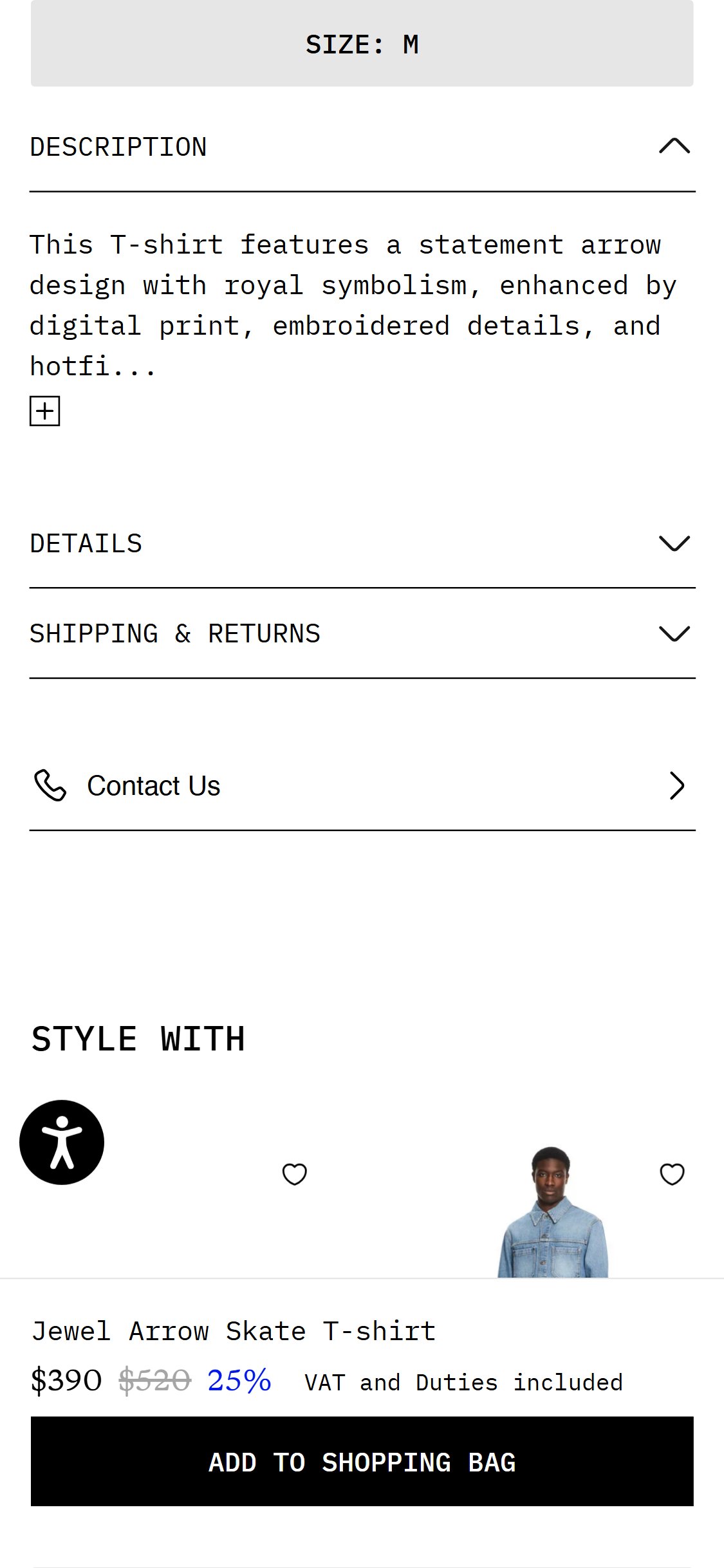
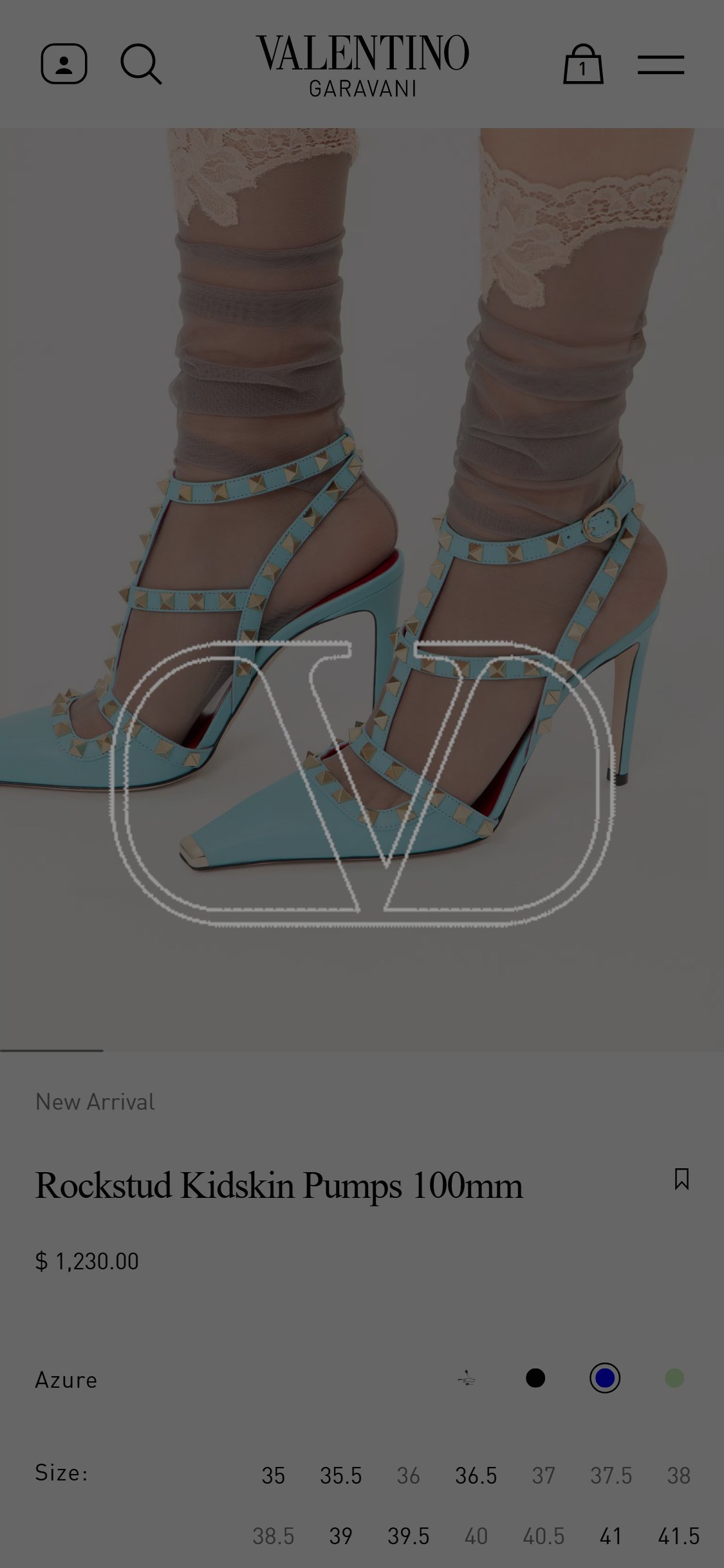
- After clicking 'Add to Shopping Bag', the page shows no visible feedback — button does not change state, no drawer slides open, no toast notification appears
- The cart icon badge in the header does not visibly update to confirm the add
- User must manually open the cart flyout to verify the item was added — an extra step that creates purchase uncertainty
- The cart flyout ('Shopping Bag') does exist as a side drawer — it should open automatically on ATC to confirm the add and enable cross-sell
- Auto-open the cart flyout drawer immediately after ATC confirmation — this provides clear feedback AND creates a cross-sell opportunity
- At minimum, change the ATC button text to 'Added to Bag ✓' for 2 seconds, then revert — this costs zero UX real estate and eliminates purchase uncertainty
- The 'You might also like' section already exists in the cart flyout DOM — auto-opening on ATC would surface these recommendations automatically
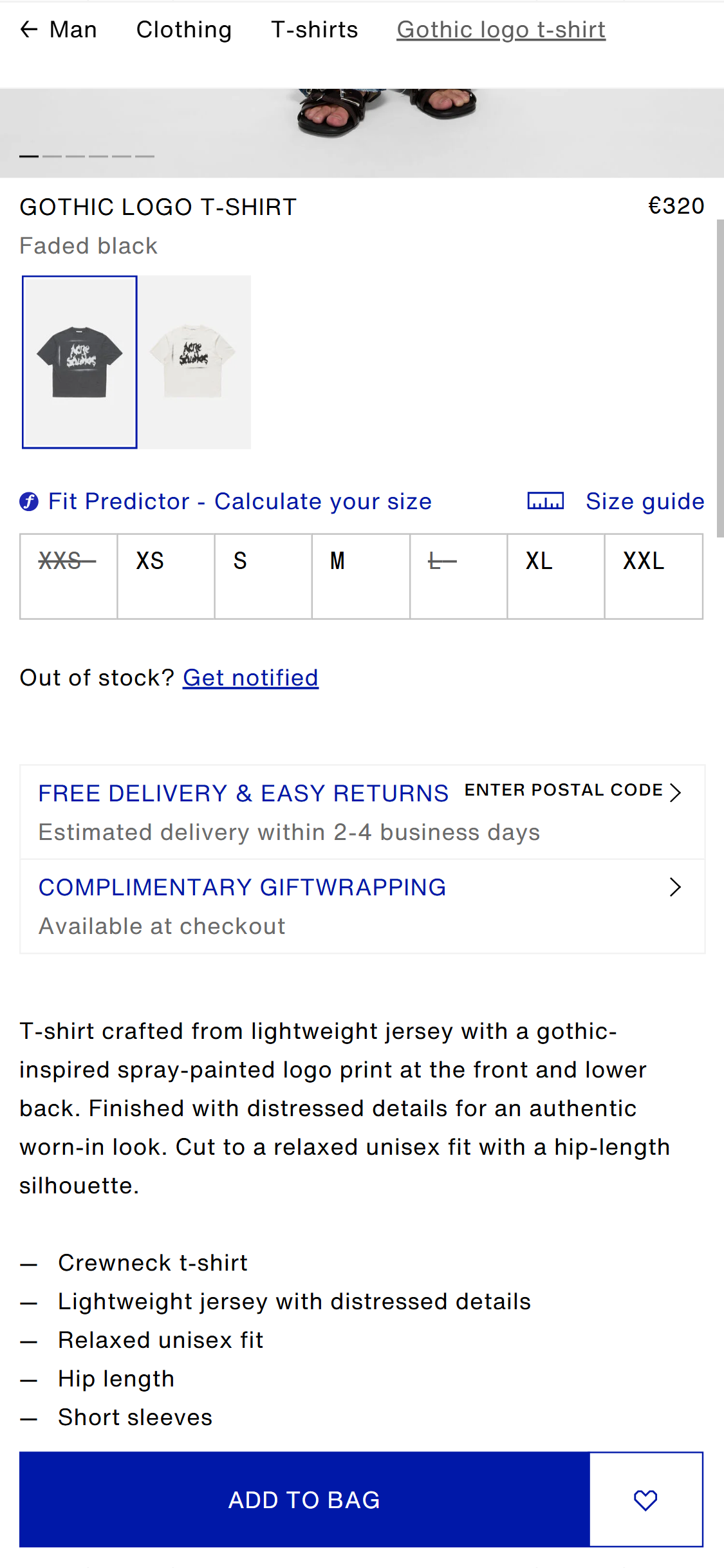
- PDP has no pincode/zipcode delivery checker and no static delivery estimation anywhere on the page
- Delivery information exists only inside the collapsed 'SHIPPING & RETURNS' accordion — requires user to expand it
- India buyers specifically check delivery timelines before committing to a purchase, especially for international brands
- Absence of delivery info on PDP forces users to checkout just to see if delivery is available to their location
- Add a pincode delivery checker ('Enter pincode for delivery estimate') near the ATC area — this is table-stakes for India e-commerce at any price point
- At minimum, show a static delivery estimate: 'Ships within 2-3 business days · Delivery in 5-7 business days across India'
- Expand the SHIPPING & RETURNS accordion content to be visible by default, or surface the delivery headline as a single line above the accordion
- Return and exchange policy is inside the 'SHIPPING & RETURNS' accordion which is collapsed by default — user must click to expand
- For fashion purchases (especially at luxury price points), returns policy visibility is a primary purchase decision factor
- India fashion return rates are high — buyers specifically look for easy return confirmation before committing to ₹30,000+ purchases
- The benchmark standard for fashion is to surface return policy as a visible badge or text near ATC, not hidden in an accordion
- Add a visible return policy callout near the ATC button: '14-day free returns' or 'Easy Exchange' as a text line or icon
- Keep the SHIPPING & RETURNS accordion for full details but surface the headline return promise (period + cost) as persistent text above it
- A small returns icon with text ('Free returns within 14 days') positioned between the ATC button and DESCRIPTION accordion would provide reassurance without disrupting the layout
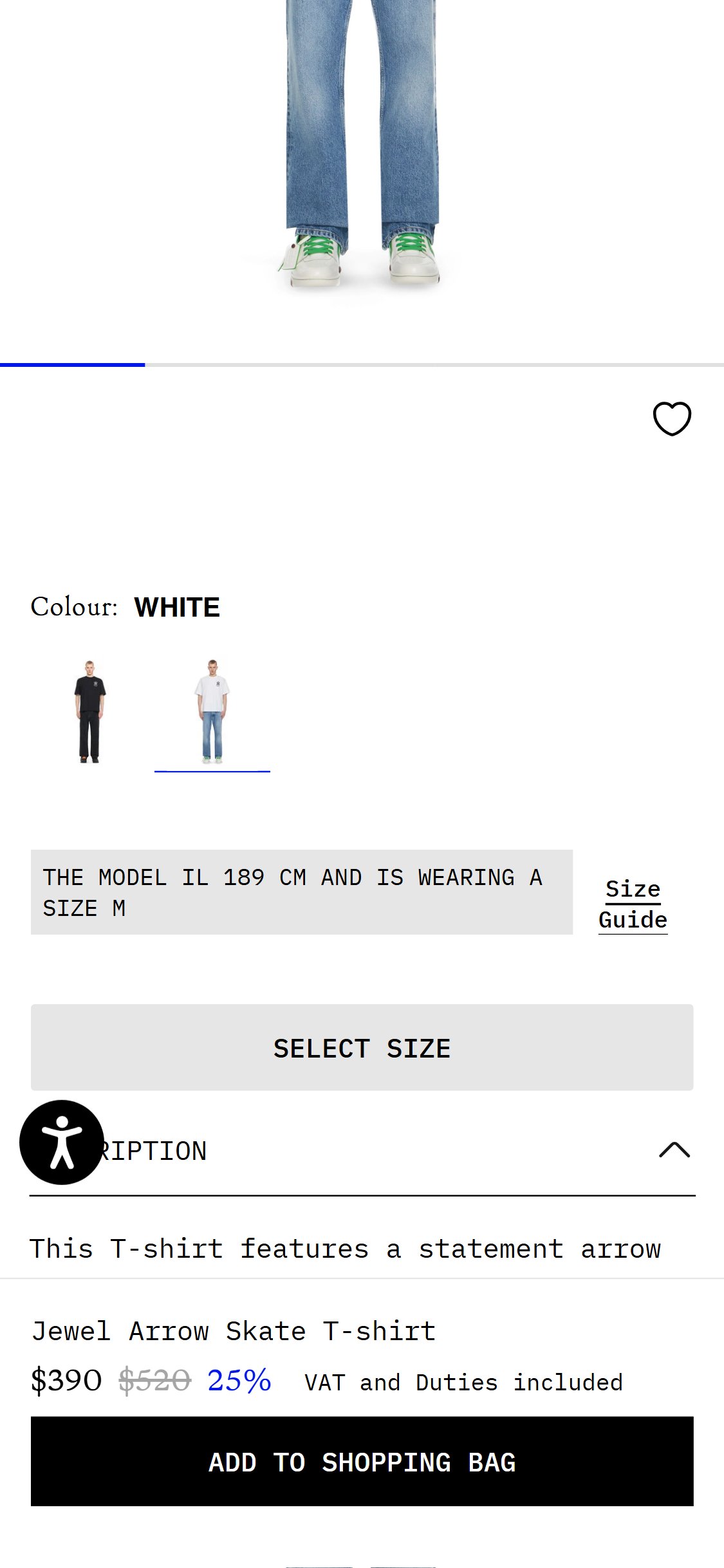

- PDP has no +/- quantity selector or dropdown — users can only add 1 unit at a time from the PDP
- To purchase multiple quantities, users must add to cart, then visit the cart to increase quantity
- For a brand selling to gift buyers or repeat customers, this adds unnecessary friction
- The ATC zone shows only size selection and the ATC button — quantity control is absent
- Add a simple +/- quantity selector between the size selector and ATC button
- Default to 1 (current behavior is acceptable for single-unit luxury purchases) but allow up to a reasonable max (e.g. 5) for gift buyers
- For luxury brand context, a minimal quantity stepper styled consistently with the brand's monospace aesthetic would work well
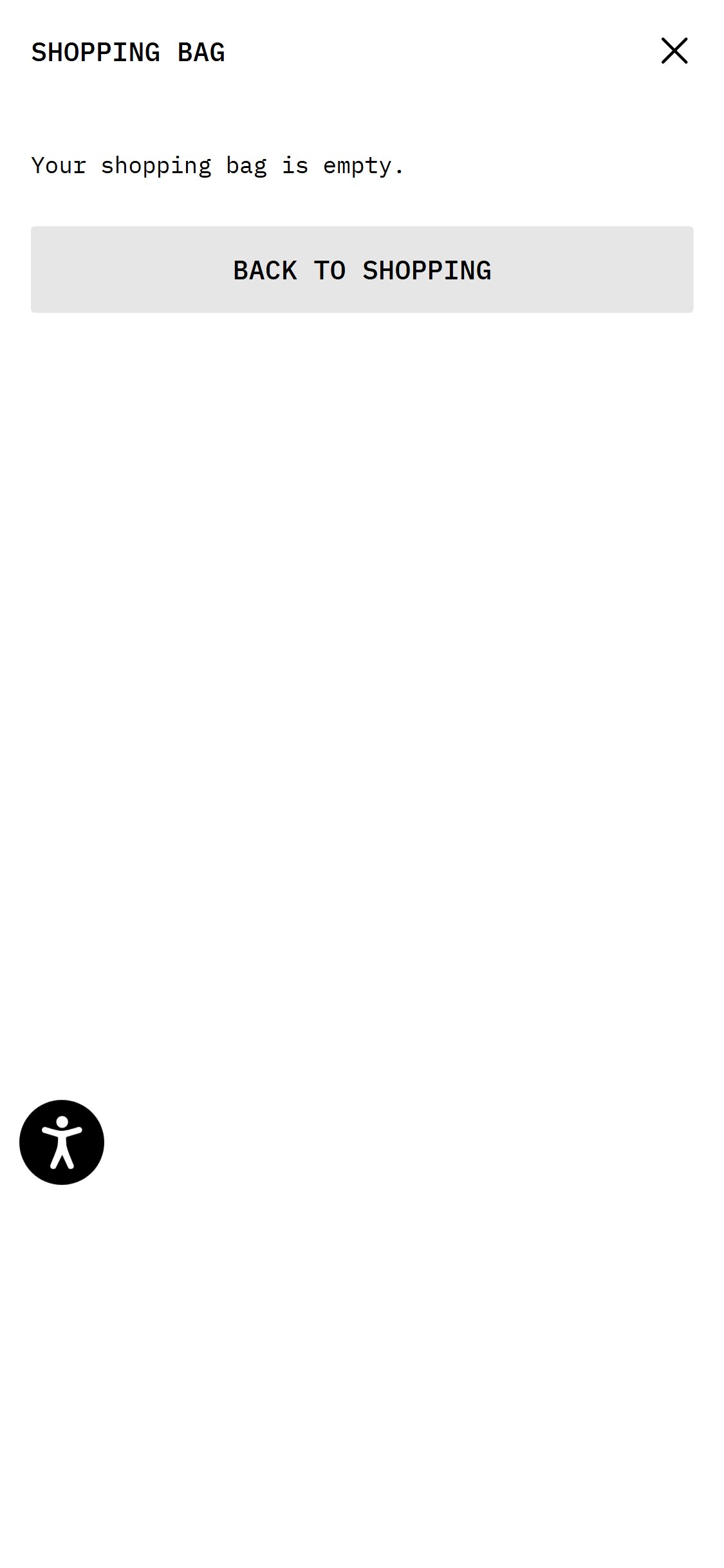

- Cart flyout shows only the empty bag state with 'Back to Shopping' — the 'You might also like' recommendation section exists in the DOM but is hidden via CSS class
- Even when populated with items, the recommendation section appears to be suppressed — missing the primary cart upsell opportunity
- The cart drawer has no cross-sell, no 'Frequently Bought Together', no 'Complete the Look' — only item list + checkout button
- Benchmark: 7/10 fashion stores show cross-sell in cart; Skims has 5 upsell sections in cart drawer
- Activate the existing 'You might also like' recommendation block in the cart flyout — it's already in the DOM, just hidden; removing the hidden class is a low-effort fix
- Populate with 3–4 complementary products using 'Complete the Look' logic (e.g. add belt, cap, sneakers when clothing is in cart)
- For luxury context, 'Style With' recommendations (matching the PDP pattern) would be brand-consistent and drive average order value
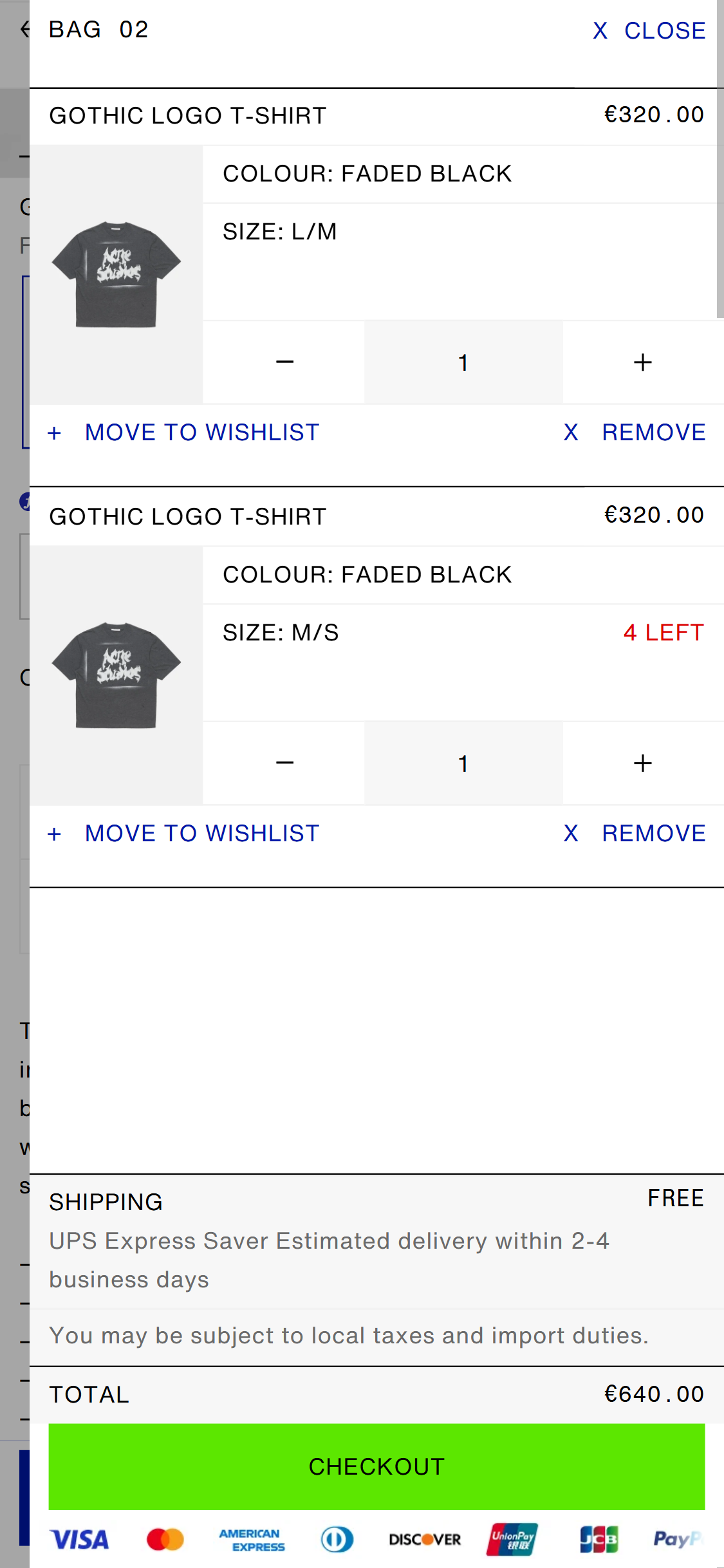
- Cart flyout shows zero urgency elements — no stock countdown, no 'items reserved for X minutes' timer, no 'Only 2 left' badge
- For a brand running 'up to 35% off' sale promotions, showing urgency in the cart would directly reinforce the sale messaging
- Sale season urgency ('Sale ends in X hours') combined with low-stock warnings would meaningfully reduce cart abandonment
- The announcement bar already communicates 'SALE SEASON: SHOP THIS SEASON'S FAVORITES AT UP TO 35% OFF' — the cart should echo this urgency
- Add per-line-item stock warnings for sizes with ≤3 units remaining: 'Only 2 left in size M' — this is the highest-leverage urgency trigger for fashion
- During sale periods, add a cart-level urgency message: 'Sale prices guaranteed only while item is in your bag'
- A subtle 'Prices may change — checkout to lock in your price' message near the checkout button costs zero UX effort and creates genuine urgency
Performance & Technology
Core Web Vitals, page-speed signals, and the technology stack powering Off-White
Core Web Vitals
Technology Stack
Performance & Technology Assessment
Mobile performance is needs work (33/100); desktop is needs work (38/100) on Salesforce Commerce Cloud (SFCC). Page-speed and Core Web Vitals are increasingly load-bearing for SEO and conversion in this category — addressing the weakest vital first is the single highest-leverage technical improvement available.
Confidential — Prepared for Off-White by Growisto | May 2026
Technology Ecosystem
Technology stack assessment — installed tools vs recommended additions for Salesforce Commerce Cloud (SFCC) stores
Present (11)
Missing (7)
App Stack Assessment
11 apps detected, 7 critical gaps identified
Confidential — Prepared for Off-White by Growisto | May 2026